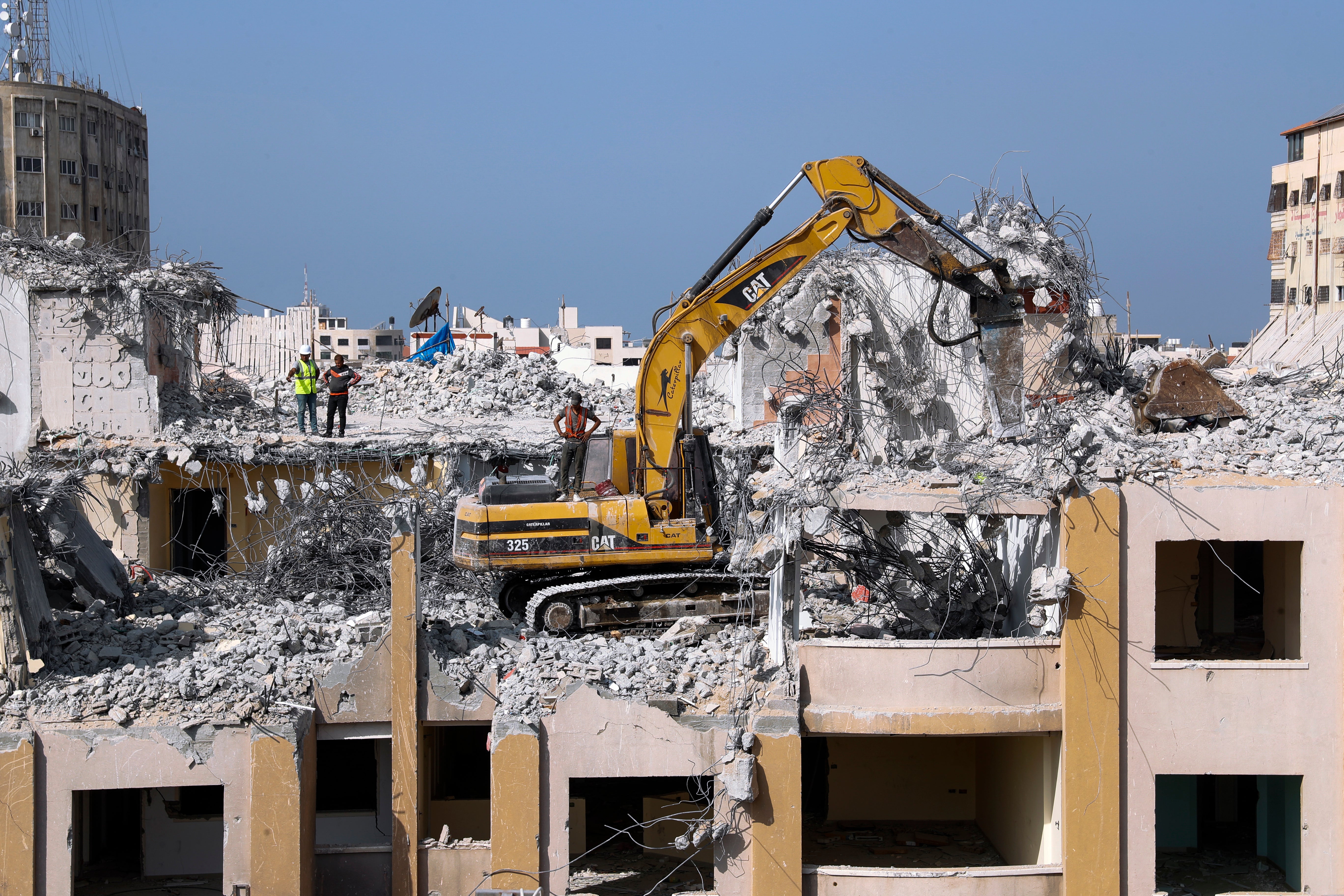
The report, titled “Environmental War Crimes: How Israel’s Military Assault Has Turned Gaza Into a Toxic Wasteland, Threatening Human Survival,” says military operations have directly affected about 78% of Gaza’s land area. The analysis drew on satellite imagery, remote sensing, scientific research and other open-source material, including a UN Environment Programme estimate that the assault has generated more than 61 million tons of debris.
Potential contamination was most pronounced in Gaza City, Khan Younis, Rafah, Jabalia and along Salah al-Din Road, areas the report says experienced sustained bombardment, ground operations, infrastructure destruction and debris accumulation. Damage to buildings, wastewater treatment plants, industrial and energy facilities, and waste systems has released contaminants including explosive residues, perchlorates, asbestos fibres, crystalline silica, persistent organic pollutants and pathogens, which can spread through air, soil, groundwater and surface water.
The report cites fecal coliforms—indicators of disease-causing pathogens—in 19% of 79 groundwater wells tested, at a rate nearly 10 times that reported in 2021. It estimates that 40,000 cubic metres of raw sewage enter the Mediterranean Sea daily; only 19% of sewage pumping stations remain functional, and 30% of the wastewater network is operational. It also identifies risks to soil in Beit Hanoun, Wadi Gaza and Khan Younis, to air in Gaza City, Jabalia and North Gaza, and to drinking water in North Gaza, Gaza City and Deir al-Balah.
Oxfam executive director Amitabh Behar said the contamination threatens health and survival now and for generations, with children and pregnant women among those at greatest risk. Lama Abdul Samad, the report’s lead author, said unexploded ordnance limits safe access to many areas and called for an on-the-ground environmental assessment. Oxfam is urging Israel to permit a full, independent field assessment and says remediation would require clearance, monitoring and specialized treatment.
The report says the findings are relevant to the Genocide Convention’s prohibition on deliberately imposing conditions of life calculated to destroy a protected group. It also argues that contamination of groundwater, soil, air and coastal waters is legally relevant under international humanitarian law. The report does not establish a legal finding of genocide.



Comments (0)
No comments yet. Be the first!