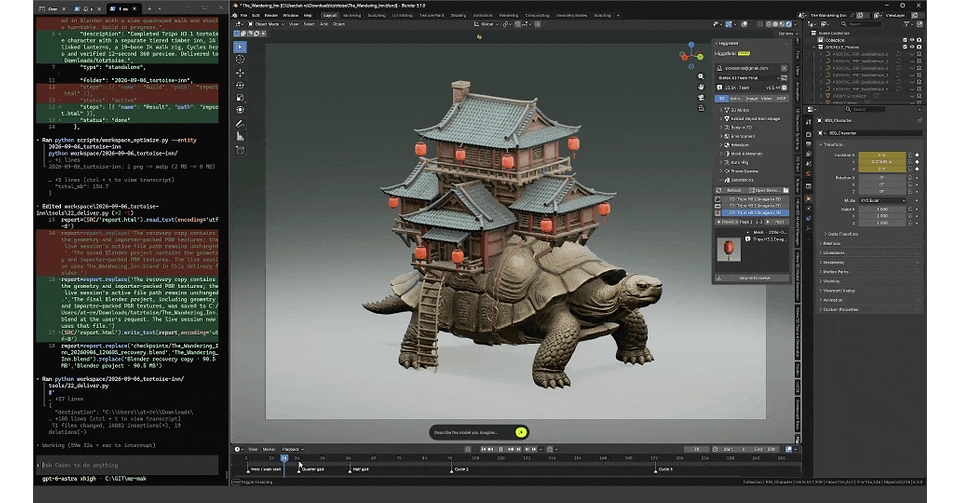
The integration addresses a fundamental gap in generative AI: while large language models excel at ideation and high-level interaction, they often struggle with the rigorous topology and mesh quality required for production-ready 3D assets. Tripo’s H series focuses on high-fidelity shapes, while their P2.0 series provides the quad topology and control needed for rigging and animation. This division of labor allows creators to bypass the tedious manual editing that typically slows down 3D development.
Practical applications have moved rapidly from theory to viral projects. Creator Stefan, for instance, refined his process by generating models with Tripo H3.1 and Blender MCP before tasking Astra with assembly and animation. Similarly, users have built functional game prototypes, including a World of Warcraft fan project completed in 90 minutes and an Alice in Wonderland-themed experience. These workflows rely on Tripo to handle the structural intelligence of 3D geometry, leaving Astra to manage the dynamic assembly and behavioral logic of the final scenes.



Comments (0)
No comments yet. Be the first!